Miami-Dade Free HIV, AIDS & STD Testing & Treatment

Who Is at Risk for HIV?
HIV can affect anyone regardless of sexual orientation, race, ethnicity, gender, age, or where they live. However, certain groups of people in the United States are more likely to get HIV than others because of particular factors, including the communities in which they live, what subpopulations they belong to, and their risk behaviors.
Communities. When you live in a community where many people have HIV, the chance of being exposed to the virus by having sex or sharing needles or other injection equipment with someone who has HIV is higher. You can use CDC’s HIV, STD, hepatitis, and tuberculosis Atlas Plus to see the percentage of people with HIV (“prevalence”) in different U.S. counties and states, as well as other data. Within any community, the prevalence of HIV can vary among different subpopulations.

Risk behaviors. In the United States, HIV is spread mainly through having anal or vaginal sex or sharing needles or syringes with an HIV-positive partner. Anal sex is the highest-risk behavior. Fortunately, there are more HIV prevention tools available today than ever before. These include using condoms correctly, every time you have sex; pre-exposure prophylaxis (PrEP), medicine people at risk for HIV take to prevent getting HIV from sex or injection drug use; and treatment as prevention, a method in which people with HIV take HIV medicine as prescribed to achieve and maintain an undetectable viral load, a level of HIV in the blood so low that it can’t be detected in a standard blood test. People with HIV who take HIV medicine (called antiretroviral therapy or ART) as prescribed and get and keep an undetectable viral load can live long and healthy lives and will not transmit HIV to their HIV-negative partners through sex.
Visit our U.S. Statistics page for more information on how HIV affects different populations.
What Should I Do If I Think I’m At Risk for HIV?
If you think you’re at risk for getting HIV, or that you might already have HIV, get tested and learn about the effective HIV prevention and treatment options available today.
Testing is the only way to know for sure if you have HIV. Find out whether testing is recommended for you.
Many HIV tests are now quick, free, and painless. Call today or register online and one of our advocates will call you to schedule your free HIV test.
Knowing your HIV status gives you powerful information to help you take steps to keep you and your partner(s) healthy:
New HIV Diagnoses Among Gay and Bisexual Men in the US and Dependent Areas by Race/Ethnicity, 2019
Among gay and bisexual men who received an HIV diagnosis in 2019, racial and ethnic disparities continue to exist.
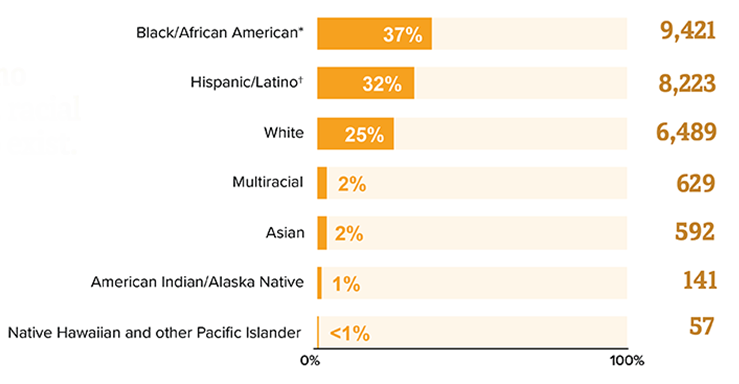
*Black refers to people having origins in any of the Black racial groups of African American is a term often used for people of African descent with ancestry in North America.
*Hispanic/Latino people can be of any race.
Source: CDC. Diagnoses of HIV infection in the United States and dependent areas. 2019. HIV Surveillance Report 2021;32.
Who is most at risk for HIV?
HIV can affect anyone, but some groups face higher risk. This includes gay and bisexual men, who account for roughly 68% of new U.S. diagnoses, transgender women who have sex with men, and people who inject drugs. Black/African American and Hispanic/Latino communities are also disproportionately affected.
What behaviors increase the risk of HIV?
The main ways HIV is transmitted are through anal or vaginal sex without protection and through sharing needles or other injection equipment. Anal sex is the highest-risk sexual behavior for getting or transmitting HIV.
Can anyone get HIV?
Yes. While certain groups are at higher risk, HIV does not discriminate. Anyone who is sexually active or shares injection equipment can be exposed, which is why regular testing and prevention are important for everyone.
Does the community I live in affect my risk?
Yes. How common HIV is within your sexual network or community affects your likelihood of exposure. In areas with higher HIV prevalence, each encounter carries a greater chance of exposure, so prevention tools like condoms and PrEP become especially important.
Does having another STD increase my HIV risk?
Yes. Having another sexually transmitted disease can increase your chances of getting or transmitting HIV. Getting tested and treated for STDs is an important part of protecting yourself.
How can I lower my risk of getting HIV?
You can reduce your risk by using condoms, taking PrEP if you are at higher risk, getting tested regularly, and never sharing needles. If you are living with HIV, staying on treatment and reaching an undetectable viral load means you cannot transmit the virus to sexual partners.
Miami-Dade leader in HIV, AIDS & STD Testing & Treatment
Call Now and Get a Free Consultation

Get in touch
We’re here to help and answer any question you might have. We look forward to hearing from you


General Office E-MAIL

Operating Hours
Monday - Friday: 8:30 AM – 5:00 PM
Our 6 Miami-Dade Locations
Test4FreeHIV is a service of Glades Medical Centers."
Test4FreeHIV has six clinics in Miami-Dade County: North Miami Beach, Miami Springs, Doral, Coral Way, Miami Lakes and Hialeah. All are open Monday to Friday, 8:30 AM to 5:00 PM. Walk in, or call 844-705-TEST (844-705-8378) to book.

Glades Medical Centers — North Miami Beach
1 NE 167th St, North Miami Beach, FL 33162
Just east of I-95 at the Golden Glades Interchange.
Glades Medical Centers — Miami Springs
4471 NW 36th St, Suite 4475, Miami Springs, FL 33166
Glades Medical Center — Doral
Glades Medical Centers — Coral Way
2648 SW 87th Ave, Miami, FL 33165
Glades Medical Centers — Miami Lakes
5753 Miami Lakes Dr, Suite E, Miami Lakes, FL 33014
Glades Medical Centers — Hialeah
Get Tested Today
Your privacy is important to us. Test4freehiv.com and its associated companies will not sell any portion of your personal contact or testing information. Information provided on this website will only be used for scheduling appointments or providing information regarding your testing and care. By submitting your name and contact information, you agree to be contacted by Test4FreeHIVand associated company representatives through a live agent, artificial or prerecorded voice, and automated SMS text at your residential or cellular number, dialed manually or by autodialer, and by email. Messaging and call rates may apply based on your particular service provider.
© TEST4FREEHIV.COM | All Rights Reserved